“I feel remarkably fortunate to have had such great care”
75-year-old Ian Mayo is now able to enjoy an active life on Scotland’s Moray coast since a pulmonary endarterectomy gave him a future beyond CTEPH. These are his experiences…
Published September 2026
“I started my journey to diagnosis when I became ill in 2021. Prior to October 2021, I had noticed in the preceding two years that on stairs and walking uphill, I was becoming breathless. At that time, I was living in Staffordshire, England. In October 2021, arriving back in the UK from a short holiday in Malta, I could not manage to walk to passport control and needed assistance. The following morning, my wife told me that I was not meant to look like a Smurf (I was blue) and took me to A&E. Within an hour, I was in a ward – where I remained for a week.
I clearly remember one of the consultants in the hospital in Stafford telling me about a brilliant TV series, ‘Surgeons: The Edge of Life’, which featured an episode about a pulmonary endarterectomy – in his words, an operation I would ‘never, ever need’. It turned out very differently! The episode was fascinating, and as it happens, it really helped as when the surgery was offered to me a few years later, I had an idea of what was involved.
My symptoms persisted, and I thought, ‘I’m not dying in England’, so my wife and I moved back up to Scotland in June 2022 – it was time to come home.
Once back up north I went through the Scottish NHS process, that concluded in undergoing four days of tests in October 2022 at the Scottish Pulmonary Vascular Unit in Glasgow. This confirmed the chronic thromboembolic pulmonary hypertension (CTEPH). I felt comfortable that they had finally discovered what it was, but the next step was what they could do about it. I was already on a blood thinner, so the pulmonary endarterectomy (PEA) was discussed with me, and I was referred for a consultation back down in England at Royal Papworth Hospital – the only UK hospital that carries out the procedure.
The appointment was for January 2023, and I took a flight there and back so it could all be done in a day, and they talked me through the whole procedure. It wasn’t a difficult decision for me. I had to consider the risk, of course, but the risk of not having it felt worse. My wife and I discussed it, and she was in total agreement that it was the best option.
I felt a lot more positive following the consultation, and on the flight back up to Scotland, I felt relieved that something was going to be done.
I was looking forward to the chance of things getting better, as the symptoms had made things very difficult.
The house we bought when we moved back up north looked out over the sea, which was important to us, but the downside at the time was that it was an old three-storey house – and all the stairs were a problem with my health condition! Stairs and hills were beyond me then; I just couldn’t manage them, as I couldn’t breathe.
With the decision about the surgery made, it was then a case of going onto the waiting list. I was only on it for four-and-a-half months, and the procedure took place in June 2023.
My wife and I drove down to Papworth, which took seven hours, but it felt preferable to flying following surgery. We broke up the journey back by staying overnight at Gretna Green.
I was in hospital for nine days (including the evening before and the morning of discharge), with less than two of those in intensive care. There were no complications, and I’m told all the clots were cleared. I have a picture of them all to prove it! It’s hard to believe how I could even move or breathe with them in there.
I was wary of the chest wound, where they opened me up, but within a month, I was starting to move around ‘normally’. It was very quick, although my wife tried to make sure I did what I was told!
The surgery has made a huge difference to my life
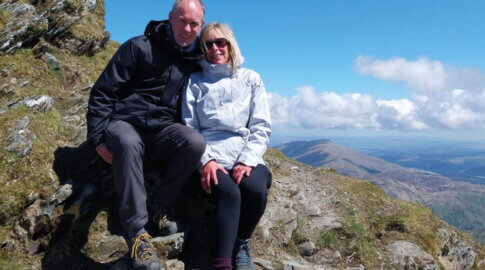
I can do so much that I was unable to do before. I’d hate to think what would have happened if I’d not had the PEA. We do a lot of walking with our dog, and I cycle too. There is a lot of countryside to enjoy up here, and I’d say I live an active life.
The care I received at the hospitals in both Glasgow and Papworth was excellent, and I was very impressed with both. The teams were always at the end of a phone call or email, and that made life a lot easier by taking the worry away. My wife has been a huge source of support throughout it all too.
In January of this year, 2026, I was officially discharged from the PH service. I feel remarkably fortunate to have had such care, and I hope that by sharing my experiences I will help other people who perhaps are worried or nervous about undertaking such surgery.
My biggest piece of advice is simply to look forward. Yes, there is risk with this operation, but there is also risk in crossing the road or driving down the M1. The surgery gave me a ‘normal’ life back.
The care I received from both Glasgow and Papworth was outstanding, and I can’t praise them enough. Put your trust in the teams looking after you. They are true specialists, and I think that’s what makes it so comforting – you are truly being looked after by the best. My only regret is that I did not seek medical care when my breathlessness started, but waited until becoming a Smurf.”